Gilbert Blythe
Anne of AvonleaGilbert Blythe develops from a capable young teacher and community organizer into an aspiring doctor whose future remains closely bound to Anne Shirley’s. A practical sense of service shapes his plans for work in the world; a more private devotion shapes the way he regards Anne. The contrast between his outspoken ambitions and his guarded feelings gives his story its gradual movement: he can speak plainly about what he hopes to do for others, but he does not risk declaring what he hopes for from her.
Identity and Ambition
By the time Anne and Gilbert discuss their futures, he has decided to become a doctor. He describes medicine as a way to fight disease, pain, and ignorance, and to do honest work that contributes to knowledge accumulated by earlier generations. His ambition is not presented as a pursuit of status: he thinks of it as repayment to those who came before him and a contribution to those who will follow. Anne, imagining a different kind of service, hopes to add beauty and happiness to people’s lives. Their exchange makes their temperaments distinct without setting them at odds: Gilbert’s ideal is active and public, while Anne’s is imaginative and personal.
That professional decision follows a period of study and teaching. In the summer, Anne tells Mrs. Allan that she and Gilbert are nearly finished with Virgil and plan to stop studying until September. The detail places their friendship within a shared intellectual life: they work toward further education even as their immediate responsibilities keep them in Avonlea and nearby communities. Gilbert’s later resignation from his White Sands teaching post and the expectation that he will attend college in the fall mark a decisive next step toward the future he has been considering.
Teaching and Civic Work
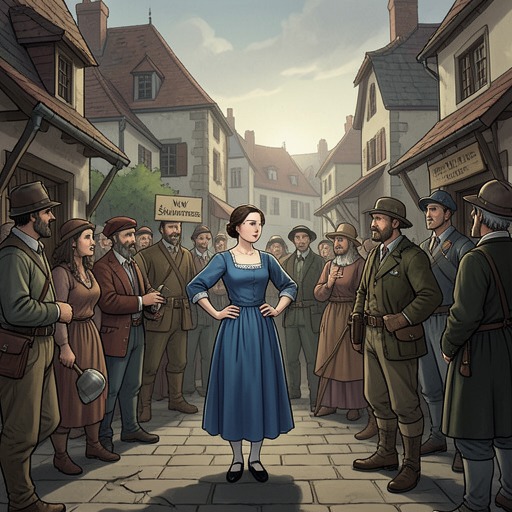
On the eve of the September school opening, Gilbert meets Anne and Jane Andrews at the Birch Path, where it joins the main road. Jane is going to Newbridge and Gilbert to White Sands; Anne, by contrast, will teach her former schoolmates. Gilbert is thus part of the same young generation entering the work of teaching, but his post also gives him a life beyond the immediate village. He is enthusiastic about Anne’s plan to form an improvement society, and, despite teaching away from home, he is expected back in Avonlea from Friday night until Monday morning.
The Avonlea Village Improvement Society becomes a concrete expression of Gilbert’s public-mindedness. He serves as its president, with Fred Wright as vice-president, Anne as secretary, and Diana Barry as treasurer. The Improvers meet every fortnight at members’ homes. Because the season is already advanced, they do not expect to accomplish many physical improvements immediately; instead, they plan a campaign for the following summer, exchange ideas, prepare and read papers, and try to educate public opinion. Gilbert and Anne have already imagined a better Avonlea together, although the wider community does not yet share a clear picture of what their program entails.
The society initially meets skepticism and ridicule. Some residents treat the Improvers as a social club, while others exaggerate their proposals into demands to rebuild houses, decorate roadsides with flowers, or beautify farm buildings in outlandish ways. Gilbert’s later report to Anne shows that the organization has moved beyond this experimental, mocked stage. Major Spencer plans a row of white birches along his farm road frontage, and William Bell intends to plant a spruce hedge along his road and lane. Gilbert says older residents are taking an interest and that people in White Sands are discussing a society of their own. Even Elisha Wright, previously among the skeptics, has changed his view after visitors praised Avonlea’s roadsides as especially attractive. The society’s influence is therefore measured not only by its own projects but by how its ideas take hold among residents and spread beyond the village.
Gilbert’s account also makes improvement collaborative rather than merely ornamental. The Ladies’ Aid Society is considering work on the graveyard, and Anne observes that the Improvers had helped bring the need to its attention unofficially. Trees planted on the church grounds are flourishing, while trustees have promised to fence the school grounds the next year. Anne hopes to mark that work with an Arbor Day on which each pupil plants a tree, and to create a garden near the road. Gilbert’s encouragement and Anne’s plans show the society’s civic ideas passing between organizations, public spaces, and the school.
Friendship and Unspoken Love
Gilbert’s feelings for Anne develop inside a friendship that he understands more clearly than she does for most of the story. At the Dryad’s Bubble, Anne recognizes that he is no longer a schoolboy: he is tall, broad-shouldered, and handsome, though he does not resemble the melancholy, mysterious ideal of a man that she and Diana had imagined. She quickly sets aside the mismatch as irrelevant to friendship. The scene records a change in Anne’s perception of Gilbert’s maturity, but not yet a change in how she names their bond.
For Gilbert, Anne already answers his ideal of a woman, down to the seven freckles she dislikes. His admiration rests not only on her appearance but on her character. He values her freedom from petty jealousies, little deceits, and bids for favor, seeing her transparent motives and high ideals as a lasting influence on those around her. He hopes to remain worthy of her friendship and perhaps, one day, her love. Yet he keeps those hopes to himself: he expects her to reject sentiment or laugh at him, and his knowledge of her response restrains him from speaking plainly.
That private devotion is connected to, but distinct from, their shared work. Gilbert encourages Anne’s civic undertaking, studies alongside her, and treats their future as a subject for earnest conversation; none of those forms of companionship is itself a declaration. His affection instead appears in the standard he sets for his own conduct and in the future he imagines. The novel gives readers access to that hope while Anne remains unaware, creating an asymmetry that lasts until the final scene.
Public Voice and Departure
Gilbert’s humor and willingness to collaborate with Anne surface in the Avonlea Notes published under the signature Observer in the Charlottetown Daily Enterprise. Local gossip wrongly attributes the notes to Charlie Sloane, partly because one appears to sneer at Gilbert and because village opinion casts the two young men as rivals for the favor of a gray-eyed girl. In fact, Gilbert and Anne have written the notes together, and the apparent reference to Gilbert is a deliberate blind. The episode turns public rumor into a joke shared by the pair: the community confidently invents an author and a rivalry, while the supposed target has helped construct the misdirection.
Later, Rachel Lynde reports that Gilbert has resigned from White Sands and supposes he will leave for college in the fall. The news places his professional transition alongside Anne’s unresolved prospects. When Marilla asks whether Anne would like to go too, Anne says she would, but that it is not possible. Gilbert’s departure is therefore more than a change of workplace: it opens a new stage for his education while raising the question of whether Anne can share that future. The available scene leaves the obstacle in place rather than resolving it immediately.
Recognition and Narrative Ending
After the wedding of Miss Lavendar and Stephen Irving, Gilbert finds Anne alone outside Green Gables, tired from the evening’s work but still absorbed in thought. She is reflecting on the couple’s reunion after years of separation and misunderstanding. Gilbert answers by imagining the greater beauty of a life shared without that separation, a remark that turns Anne’s thoughts toward the possibility of love within a long friendship. For the first time, her gaze falters beneath his, her face flushes, and the familiar relationship appears newly illuminated to her.
The recognition is brief and not yet a full confession or resolution. The veil of understanding seems to fall again, but Anne walks away changed: the novel presents her movement from girlhood toward womanhood through this altered awareness. Gilbert says nothing more. Instead, he reads promise in her blush and imagines the four years ahead as a period of earnest, happy work, ending in useful knowledge gained and a beloved heart won. That future is presented as his expectation, not as an event already completed. His ending thus joins professional aspiration to romantic hope: the doctor who wants to contribute to the lives of others looks toward a future in which Anne may choose to share his own.